
Baseball lost a legend last week with the passing of Willie Mays. Many fans consider Mays to have been the greatest player in the history of Major League Baseball. I understand that sentiment and will borrow a quote from Dizzy Dean and say that if Mays wasn’t the greatest player of all time then he certainly was “among ‘em.”
I do not remember the Willie Mays of the over-the-head catch in the outer limits of the Polo Grounds in the 1954 World Series or the Willie Mays who was a threat to hit 40 homers virtually every season. I started following baseball in 1966, the year Mays turned 35, and it was his last really great season. Still, reviewing his career stats, hearing stories from those who saw him in his prime, and watching video of him in action, I can see how so many fans believe he was the greatest. He was special.
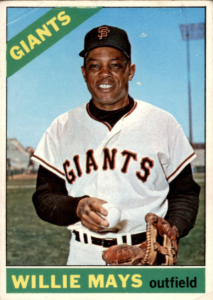
My favorite memories of Mays involve acquiring one of his baseball cards and witnessing one of his home runs. I started collecting baseball cards in 1966, but I did not get a Willie Mays (Topps #1) that year. The following year, I had a fistful of my 1967 cards at school one day when Ronnie Smith, a friend of my older brother, John, spotted them and asked the obvious question, “Do you collect baseball cards?” After I told him that I did, he said, “Well, I have a Willie Mays card you can have. I’ll bring it to you tomorrow.”
I was excited about adding Mays to my collection, but when Ronnie showed up with the card, it was the 1966 Topps, not a 1967 Topps (#200). This was before there were people selling old cards for hundreds of dollars, so I didn’t have enough sense to realize I was getting a valuable card. I took the card from Ronnie, thanked him, and stifled my disappointment. I don’t know what became of the card, but I wish I still had it.
Using Retrosheet.org, I was able to find the Mays homer I witnessed. It came on a hot, mid-July Sunday afternoon in Atlanta in 1971. In those days, the Braves had one weekend every season where one team would come in for three-game series beginning on a Thursday evening, and then another team came in on Sunday for three games in two days, with the series opening with a doubleheader.
The Atkins clan from Cheap Hill, Tenn. traveled down to Atlanta and watched the Braves play the Los Angeles Dodgers Friday and Saturday nights, and then stayed for the doubleheader against the San Francisco Giants on Sunday.
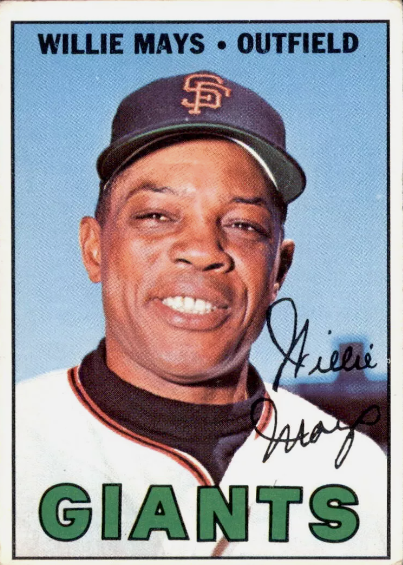
With one out in the top of the sixth inning of the second game, Mays came to the plate with a runner on second base and the Braves leading 4-0. Mays was hitting .287 with 14 home runs and 40 runs batted in for the season when he launched the 643rd homer of his career.
1971 was the last productive season for Mays. He finished the year with 18 home runs, 61 RBIs, and a .271 batting average. He led the National League in walks (112) and on-base percentage (.425)–not bad for a 40-year-old. Early the following season, the Giants traded Mays to the New York Mets. By that time, his glory days were way behind him, although he did play in one final World Series in 1973.
At 93, Willie Mays was the oldest living member of the Baseball Hall of Fame. That distinction now passes to Luis Aparicio, who turned 90 at the end of April.
(All statistics are from Retrosheet and Baseball Reference. Game details are from Retrosheet.)


 Cheap Hill 44
Leave a reply to cheaphill44 Cancel reply