
Last week, the Society for American Baseball Research (SABR) sent out the MLB Report on Pitcher Injuries. Included with the report was a cover memo from the Office of the Commissioner that said: “In response to the long-term increase in pitcher injuries at the amateur and professional levels, MLB interviewed more than 200 subject-matter experts from a variety of disciplines across all levels of the sport to better understand the industry’s perspectives on factors that have contributed to this increase over the past several decades.”
After talking with these subject matter experts, the report basically concluded that increased velocity was the major contributing factor to the increase in pitcher injuries. The report did not identify any of the “subject-matter experts” by name, but I assume one of them must have been noted radio host, Mr. Obvious. Did we really need over 200 experts and a 62-page report to tell us that pitchers throwing as hard as they can on virtually every pitch is leading to an increase in injuries?
SABR also facilitated an online panel discussion on the report with four professionals from the field of biomechanics, all of whom kept coming back to the fact that the harder someone throws a baseball, the more valgus torque there is on the elbow, which puts outward stress on the anterior cruciate ligament (ACL).
The experts pointed out that while muscles around the ACL absorb some of this torque, and there are training programs to strengthen those muscles, there is no training that can strengthen ligaments. Basically, the experts agree that the normal human arm is just not built to withstand the overwhelming stress of throwing a baseball at the speeds we see in today’s game.
The most obvious attempt to alleviate injuries has been for teams to limit the number of pitches and innings they expect their pitchers to throw. Some of the experts believe that such limitations actually may contribute to the problem. Their thinking is that if the pitcher knows he is limited to five innings going into the game, he will throw with maximum intensity on virtually every pitch since he knows he won’t be around for the later innings.
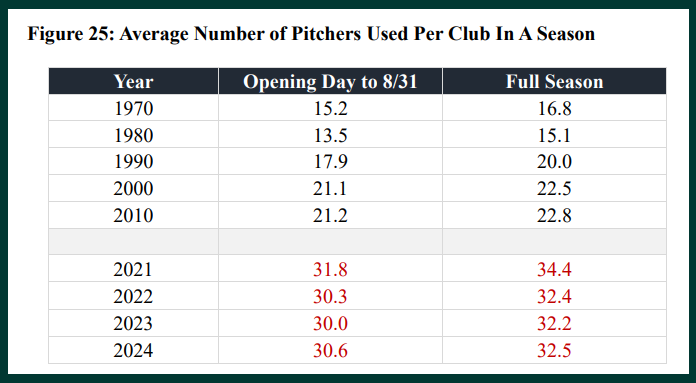
The makeup and management of rosters also contributes to the problem. Teams are allowed to carry 13 pitchers, so managers can have the starter go five innings and then use four different pitchers to close out the game. And when the bullpen starts to wear down, they shuttle pitchers to and from the minor leagues to keep fresh arms available, a process the report calls “churning.”
Also, there is no incentive for pitchers to go longer in their starts. They still get huge contracts, and they get paid and accrue major league service time when they land on the injury list.
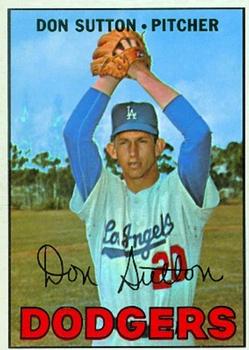
One quibble I have with the report is that it says pitchers nowadays throw most of their pitches with “maximum” effort. I contend that Don Sutton, Tom Glavine, and Jim Kaat threw every pitch with maximum effort; they just had enough sense not to throw every pitch with maximum exertion.
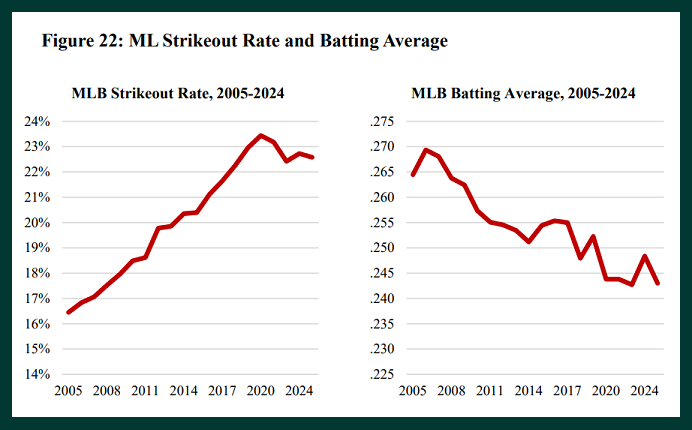
Though not stated in the report, my major takeaway was that all the emphasis on velocity is not only the major causative agent in the epidemic of arm injuries, but also the biggest factor in why the game has changed so drastically–in what I believe to be the wrong direction–over the past few years.
Now that the velocity genie is out of the bottle, I don’t see a path for baseball ever to return to the game I grew up loving. And that’s a shame.


 Cheap Hill 44
Leave a reply to CheapHill44 Cancel reply